

Machine learning is everywhere—from the recommendations on your favorite streaming app to fraud detection in online banking—yet it often feels confusing and overly technical. This guide simplifies machine learning fundamentals so you can understand how computers learn from data, recognize patterns, and make decisions without being explicitly programmed for every task. Designed for students, educators, and curious minds, it breaks down core concepts, key types of learning, and real-world applications in clear, approachable language. By the end, you’ll see how machine learning works behind the scenes and why it plays such a powerful role in shaping the technology you use every day.
The Three Core Flavors of Machine Learning
Understanding the fundamentals of machine learning can enhance your ability to implement advanced security measures, such as zero trust architecture, in modern networks – for more details, check out our Implementing Zero Trust Architecture in Modern Networks.
When people first hear about AI, it can sound abstract and intimidating. In reality, most systems fall into three practical categories. Understanding these is part of grasping machine learning fundamentals—and in my opinion, once you see the patterns, the mystery fades pretty quickly.
Supervised Learning: The “Flashcard” Method
To start, supervised learning is the most common approach. The model trains on labeled data—meaning each input comes with a correct answer. Think of a student studying with flashcards: question on one side, answer on the other.
For example, email spam filters learn from thousands of emails labeled “spam” or “not spam.” Image recognition systems train on photos already tagged “cat,” “car,” or “traffic light.” Over time, the system maps inputs to outputs with impressive accuracy (yes, this is how your phone knows it’s looking at your dog and not a loaf of bread).
Some critics argue supervised learning is limited because it requires massive labeled datasets, which can be expensive to create. That’s true. However, when accuracy and predictability matter—like fraud detection—it’s still incredibly effective.
Unsupervised Learning: Finding Hidden Patterns
On the other hand, unsupervised learning works with unlabeled data. No flashcards. No answer key.
It’s more like dumping out a box of mixed Lego bricks and sorting them into logical groups. The algorithm looks for structure—clusters, similarities, anomalies. Businesses often use this for customer segmentation, grouping buyers by behavior rather than guesswork.
Admittedly, results can be harder to interpret. But when exploring unknown territory, this approach shines.
Reinforcement Learning: Trial and Error
Finally, reinforcement learning is about action and reward. An “agent” interacts with an environment and learns through feedback—rewards for good decisions, penalties for bad ones.
It powers game-playing AI and robotics. Think of training a dog with treats, except the “dog” might be a robot learning to walk.
If you’re curious how these systems process data closer to its source, you might also explore what is edge computing and why does it matter.
Personally, I find reinforcement learning the most fascinating. Watching a system improve through pure iteration feels almost cinematic—like Rocky, but with algorithms.
From Data to Decisions: A Simple Look at the Learning Process
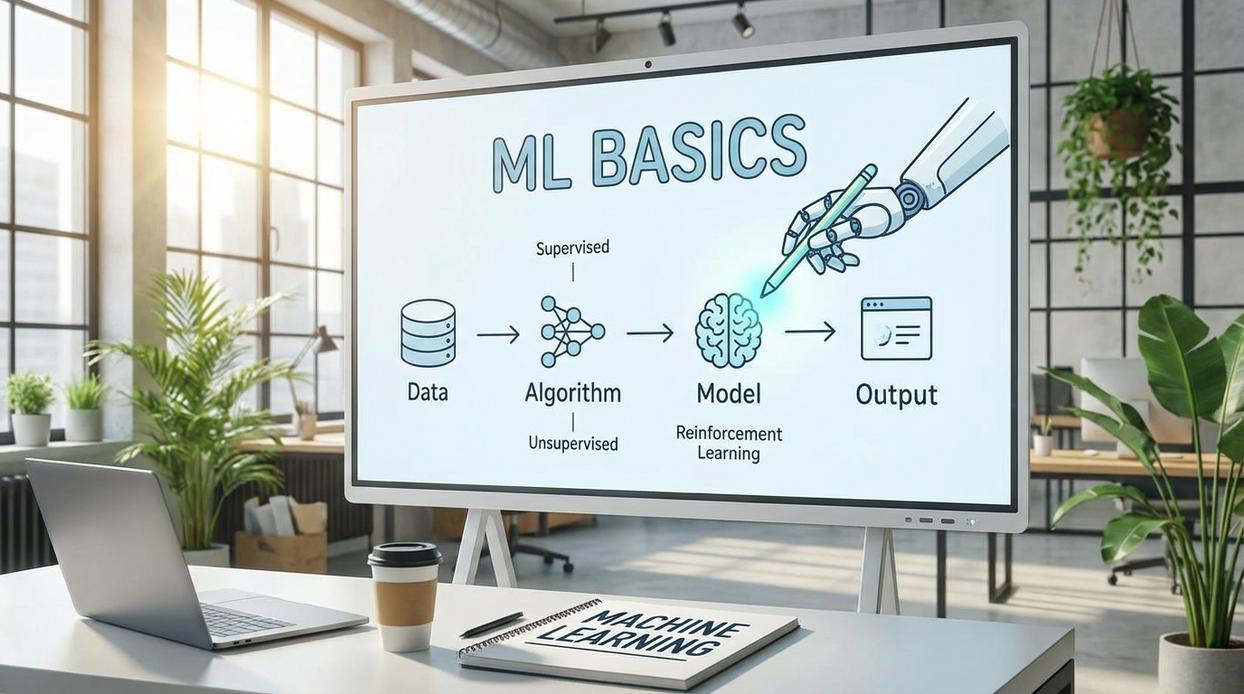
Step 1: The Importance of Data
Here’s the uncomfortable truth: most machine learning failures aren’t algorithm problems—they’re data problems. A model is only as smart as what it reads. Think of it like a library. If you stock it with outdated, biased, or tiny collections, you’ll produce narrow thinking. Garbage in, garbage out (yes, it’s a cliché because it’s true). Contrary to the hype, fancier models rarely fix weak datasets. BETTER DATA beats flashier code almost every time. Research from MIT has shown that dataset quality directly impacts model reliability more than marginal architecture tweaks.
Step 2: Training the Model
Training is the studying phase. The algorithm scans examples, detects patterns, and builds internal rules—its own working “logic.” This is where machine learning fundamentals come into play: models adjust parameters to minimize error. Many assume the system “understands” the material. It doesn’t. It calculates probabilities. Think less genius, more statistician with infinite patience.
Step 3: Making Predictions (Inference)
Now comes the test. The trained model sees new, unseen data and makes an educated guess. This process, called inference (using learned patterns to predict outcomes), is where practical value appears. Like a student facing surprise exam questions, it applies what it practiced.
Step 4: Feedback and Refinement
Here’s what people underestimate: learning doesn’t stop after deployment. Engineers measure accuracy and feed corrections back into the system. If predictions miss the mark, adjustments follow. It’s a loop of trial, error, and refinement—less “set it and forget it,” more continuous improvement. Even Iron Man upgraded his suits.
Machine Learning in Your Everyday Life
Machine learning isn’t some distant sci‑fi concept—it’s quietly embedded in your daily routine. At its core, it relies on machine learning fundamentals: systems that learn patterns from data and improve predictions over time without being explicitly programmed for every scenario.
Entertainment and Content
Streaming platforms analyze billions of interactions daily. Netflix has reported that over 80% of the content watched on its platform is driven by its recommendation system (Netflix Tech Blog). By comparing your viewing history with users who share similar tastes, algorithms predict what you’re likely to enjoy next. Spotify’s Discover Weekly follows a similar model, blending collaborative filtering (group behavior patterns) with natural language processing of song metadata.
Communication and Security
Spam filters use supervised learning—models trained on labeled examples of “spam” and “not spam.” Google once disclosed that its AI-driven filters block more than 99.9% of spam, phishing, and malware (Google Safety Report). Banks apply anomaly detection systems to flag unusual spending in milliseconds, reducing fraud losses that reached $10 billion in the U.S. in 2023 (FTC).
Navigation and Logistics
Google Maps aggregates anonymized real-time data from millions of devices to predict traffic and reroute drivers dynamically.
Smart Devices and Assistants
Voice assistants convert speech to text using deep neural networks trained on massive audio datasets—proof that your casual “Hey Siri” activates serious computational power.
Your Next Steps in the World of AI
You came here to make sense of artificial intelligence, and now you have a clear understanding of the three main types of ML and how systems learn from data. What once felt like a mysterious black box is now something far more practical: a pattern-recognition engine that powers recommendations, security systems, and smart devices you use every day.
By strengthening your grasp of machine learning fundamentals, you’ve taken the most important first step toward confidently navigating innovation, emerging technologies, and secure digital systems. That foundation removes confusion and replaces it with clarity.
Now it’s time to move from understanding to action. Explore beginner-friendly resources on algorithms like Decision Trees or experiment with a no-code ML platform to see these concepts come alive. The more you interact with real tools, the faster your confidence will grow. Start building, start experimenting, and turn today’s knowledge into tomorrow’s capability.

 Ask Zelviera Durnhanna how they got into device troubleshooting guides and you'll probably get a longer answer than you expected. The short version: Zelviera started doing it, got genuinely hooked, and at some point realized they had accumulated enough hard-won knowledge that it would be a waste not to share it. So they started writing.
What makes Zelviera worth reading is that they skips the obvious stuff. Nobody needs another surface-level take on Device Troubleshooting Guides, Core Tech Concepts and Basics, Emerging Device Breakthroughs. What readers actually want is the nuance — the part that only becomes clear after you've made a few mistakes and figured out why. That's the territory Zelviera operates in. The writing is direct, occasionally blunt, and always built around what's actually true rather than what sounds good in an article. They has little patience for filler, which means they's pieces tend to be denser with real information than the average post on the same subject.
Zelviera doesn't write to impress anyone. They writes because they has things to say that they genuinely thinks people should hear. That motivation — basic as it sounds — produces something noticeably different from content written for clicks or word count. Readers pick up on it. The comments on Zelviera's work tend to reflect that.
Ask Zelviera Durnhanna how they got into device troubleshooting guides and you'll probably get a longer answer than you expected. The short version: Zelviera started doing it, got genuinely hooked, and at some point realized they had accumulated enough hard-won knowledge that it would be a waste not to share it. So they started writing.
What makes Zelviera worth reading is that they skips the obvious stuff. Nobody needs another surface-level take on Device Troubleshooting Guides, Core Tech Concepts and Basics, Emerging Device Breakthroughs. What readers actually want is the nuance — the part that only becomes clear after you've made a few mistakes and figured out why. That's the territory Zelviera operates in. The writing is direct, occasionally blunt, and always built around what's actually true rather than what sounds good in an article. They has little patience for filler, which means they's pieces tend to be denser with real information than the average post on the same subject.
Zelviera doesn't write to impress anyone. They writes because they has things to say that they genuinely thinks people should hear. That motivation — basic as it sounds — produces something noticeably different from content written for clicks or word count. Readers pick up on it. The comments on Zelviera's work tend to reflect that.