

Staying ahead in today’s fast-moving tech landscape isn’t easy—especially when breakthroughs in innovation alerts, core technology concepts, and augmented reality glasses advancements seem to emerge almost daily. If you’re searching for clear, reliable insights into what’s actually shaping the future of devices and secure digital systems, this article is built for you.
We cut through the noise to focus on what matters: meaningful emerging device breakthroughs, practical secure protocol development strategies, and step-by-step troubleshooting guidance that helps you apply new knowledge with confidence. Instead of surface-level summaries, you’ll find carefully analyzed trends, real-world use cases, and technically grounded explanations designed for both curious learners and experienced professionals.
Our insights are informed by continuous monitoring of innovation cycles, technical documentation, and evolving security standards—ensuring you get accurate, up-to-date perspectives you can trust. Whether you’re exploring new hardware capabilities or strengthening system security, this guide delivers the clarity and depth you need.
Beyond the Screen: How Wearable AR is Becoming Reality
Wearable AR is no longer sci‑fi; instead, it’s a practical upgrade to daily life. Thanks to breakthroughs in displays, chips, and sensors, today’s devices are lighter, brighter, and smarter. So what’s in it for you?
- All‑day power: Efficient microLED displays and low‑power processors extend battery life.
- Real‑time intelligence: On‑device AI reduces lag, meaning directions, translations, and alerts appear instantly.
- Seamless mapping: Advanced depth sensors anchor graphics to the physical world.
In short, augmented reality glasses advancements translate into visuals, performance, and hands‑free productivity—benefits that turn convenience into capability.
The Visual Leap: Miniaturizing the Display Engine
Not long ago, wearable displays relied on bulky waveguides and so-called “birdbath” optics (a semi-reflective mirror system that bounces images into your eye). Effective? Yes. Subtle? Not even close. These systems added thickness, weight, and the unmistakable “I’m wearing a prototype” look. In contrast, today’s micro-OLED (organic light-emitting diode built on silicon) and microLED displays shrink the entire display engine to thumbnail size—while improving clarity. For example, Sony’s micro-OLED panels have reached over 3,000 pixels per inch (PPI), enabling compact yet razor-sharp imaging (Sony Semiconductor Solutions, 2023).
Equally important is pixel density per degree (PPD), a metric that measures how many pixels fit within a single degree of your vision. Higher PPD means smoother edges and text that doesn’t shimmer in daylight. Research suggests that around 60 PPD approaches “retina-level” clarity, where pixels become indistinguishable to the human eye (VR Industry Forum). That’s why modern overlays remain readable outdoors—something older systems struggled with.
However, clarity alone isn’t enough. Power efficiency determines whether a device lasts an hour or all day. MicroLED technology, in particular, offers significantly higher brightness per watt than traditional LCD or OLED panels (Yole Group, 2024). In practical terms, that means brighter visuals without draining a pocket-sized battery.
Finally, there’s field of view (FoV)—the extent of the observable digital area. Expanding FoV without enlarging optics is a delicate engineering balancing act. Yet recent augmented reality glasses advancements show FoV widening past 50 degrees in slimmer frames. The invisible display engine, it turns out, is becoming reality.
The Power Core: Balancing Performance and Portability
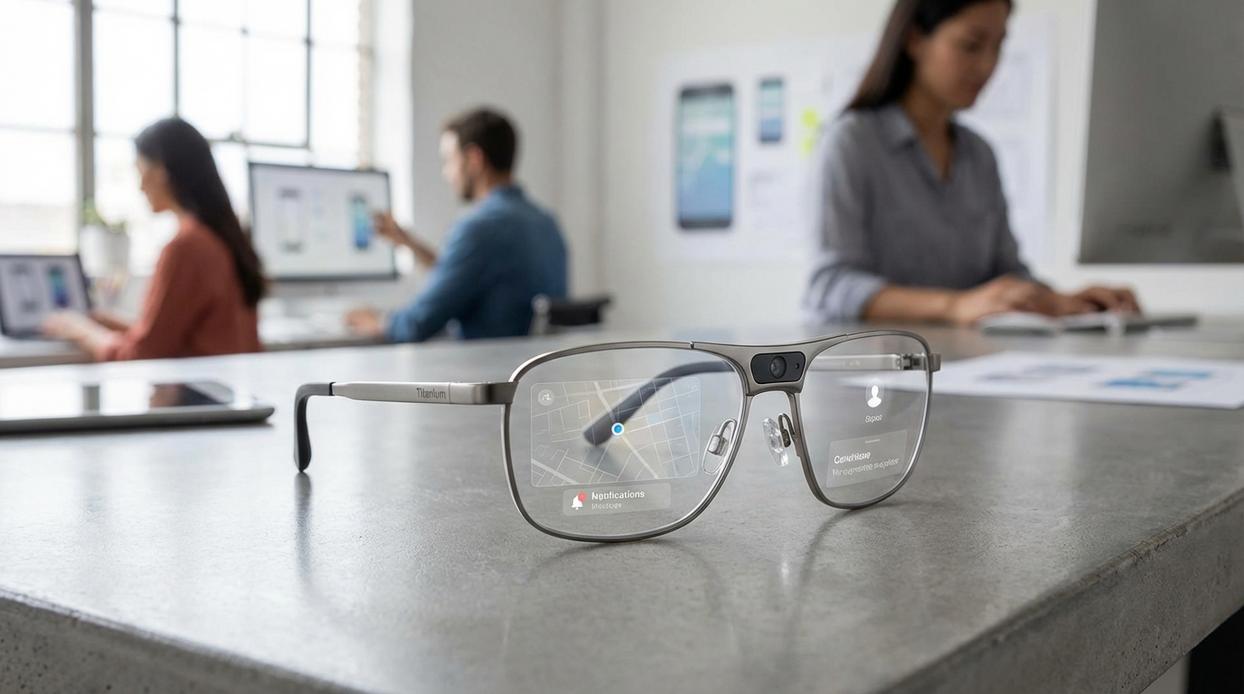
The biggest shift in wearable computing isn’t cosmetic—it’s architectural. Early AR devices relied on generic mobile processors. Today, companies are building custom Systems-on-a-Chip (SoCs) tailored specifically for AR workloads like SLAM (Simultaneous Localization and Mapping)—the process that allows a device to map its environment while tracking its own position in real time. Think of SLAM as the brain that lets digital objects “stick” to your coffee table instead of drifting like bad CGI.
Some argue off-the-shelf chips are cheaper and good enough. That’s partially true. But AR demands parallel processing for computer vision, sensor fusion, and graphics rendering simultaneously. Custom silicon reduces latency and power draw—two constraints that define head-worn devices (and user patience).
Heat is the silent dealbreaker. Compact frames leave little room for airflow, making thermal management critical. Vapor chambers—thin, liquid-filled heat spreaders—disperse thermal load efficiently. Strategic component placement moves hotspots away from skin contact areas. Without this, performance throttles fast (and nobody wants a warm temple mid-demo).
Another breakthrough is split processing architecture. Intensive tasks are offloaded to a tethered smartphone or edge cloud via low-latency wireless protocols. The glasses handle sensing and display; heavier computation happens elsewhere. Critics warn this increases dependency on connectivity. They’re right—but as 5G and Wi-Fi 7 mature, reliability concerns may shrink.
Battery chemistry is advancing too. Higher energy density cells store more power per gram, extending runtime without bulk. Pro tip: energy efficiency gains often matter more than raw capacity increases.
Looking ahead, I suspect augmented reality glasses advancements will hinge less on optics and more on silicon specialization. For deeper context, see next generation wearable technology whats changing in 2026.
Sensing the World: The Evolution of AR Perception
Modern AR doesn’t “see” the world the way we do—it calculates it. At the heart of this is the Sensor Fusion Engine, a system that merges data from high-resolution cameras, depth sensors like LiDAR (Light Detection and Ranging) and Time-of-Flight modules, plus IMUs (Inertial Measurement Units combining accelerometers and gyroscopes). Apple’s LiDAR scanner, for instance, can measure distances within nanoseconds, enabling accurate depth mapping even in low light (Apple Developer Documentation). When these streams combine, DIGITAL OBJECTS stop floating awkwardly and start anchoring convincingly to real surfaces.
Some critics argue this is overengineered—why not rely on cameras alone? Because camera-only tracking struggles with occlusion and scale. Studies from IEEE show multi-sensor fusion improves spatial accuracy by over 30% compared to monocular vision systems.
From Controllers to Intuition
Hand and eye-tracking eliminate clunky remotes. Devices now interpret micro-gestures and gaze direction in milliseconds. Meta reports sub-10ms hand-tracking latency in controlled environments—fast enough to feel NATURAL.
Secure Environment Mapping
On-device AI builds a real-time 3D mesh of your space. This enables physics-aware placement—think virtual furniture that doesn’t sink through your floor (unless you’re in a sci-fi glitch scene).
Privacy-First Protocols
Processing biometric and spatial data locally reduces breach risk. As augmented reality glasses advancements accelerate, edge computing isn’t optional—it’s ESSENTIAL.
Putting It All Together: The Path to the Mainstream
If augmented reality is going to go mainstream, connectivity is the quiet hero. High-bandwidth, low-latency standards like Wi-Fi 6E/7 and 5G make real-time data streaming possible—meaning your glasses can pull cloud-rendered graphics instantly instead of overheating on your face (no one wants a tiny furnace perched on their nose). Low latency simply means minimal delay between action and response, which is critical when digital objects must align with the physical world.
Still, even the fastest networks won’t matter without a thriving software ecosystem. Hardware breakthroughs grab headlines, but developers create the apps that solve real problems—remote collaboration, field repairs, immersive training. Some skeptics argue we already have smartphones for that. Fair point. Yet hands-free overlays can reduce cognitive load in complex tasks, and early trials in medical and industrial settings suggest measurable productivity gains (PwC, 2019).
There’s also the human factor. Social acceptance and intuitive interfaces remain unresolved. I’ll admit: it’s unclear whether voice, gesture, or eye-tracking will emerge as the dominant control method. Each has trade-offs.
What’s promising is the convergence driving sleeker devices. Recent augmented reality glasses advancements show form factors edging closer to standard eyewear—finally less sci-fi visor, more everyday frames.
Stay Ahead of the Next Wave of Innovation
You came here to better understand the fast-moving world of innovation alerts, core tech concepts, emerging device breakthroughs, secure protocol development, and practical troubleshooting strategies. Now you have a clearer picture of how these pieces connect—and why staying informed is no longer optional.
Technology evolves quickly, and falling behind can mean missed opportunities, security risks, or costly mistakes. From secure protocol development to the latest augmented reality glasses advancements, the pressure to keep up is real. The good news? You now know where to focus and how to think strategically about what’s next.
Don’t let rapid change become your biggest obstacle. Join thousands of forward-thinking readers who rely on our insights to stay ahead of emerging tech trends. Get the latest innovation alerts, deepen your technical understanding, and solve challenges faster.
Take the next step now—subscribe, explore our latest guides, and put cutting-edge knowledge to work today.

 Ask Bradford Folandevada how they got into emerging device breakthroughs and you'll probably get a longer answer than you expected. The short version: Bradford started doing it, got genuinely hooked, and at some point realized they had accumulated enough hard-won knowledge that it would be a waste not to share it. So they started writing.
What makes Bradford worth reading is that they skips the obvious stuff. Nobody needs another surface-level take on Emerging Device Breakthroughs, Insider Knowledge, Secure Protocol Development. What readers actually want is the nuance — the part that only becomes clear after you've made a few mistakes and figured out why. That's the territory Bradford operates in. The writing is direct, occasionally blunt, and always built around what's actually true rather than what sounds good in an article. They has little patience for filler, which means they's pieces tend to be denser with real information than the average post on the same subject.
Bradford doesn't write to impress anyone. They writes because they has things to say that they genuinely thinks people should hear. That motivation — basic as it sounds — produces something noticeably different from content written for clicks or word count. Readers pick up on it. The comments on Bradford's work tend to reflect that.
Ask Bradford Folandevada how they got into emerging device breakthroughs and you'll probably get a longer answer than you expected. The short version: Bradford started doing it, got genuinely hooked, and at some point realized they had accumulated enough hard-won knowledge that it would be a waste not to share it. So they started writing.
What makes Bradford worth reading is that they skips the obvious stuff. Nobody needs another surface-level take on Emerging Device Breakthroughs, Insider Knowledge, Secure Protocol Development. What readers actually want is the nuance — the part that only becomes clear after you've made a few mistakes and figured out why. That's the territory Bradford operates in. The writing is direct, occasionally blunt, and always built around what's actually true rather than what sounds good in an article. They has little patience for filler, which means they's pieces tend to be denser with real information than the average post on the same subject.
Bradford doesn't write to impress anyone. They writes because they has things to say that they genuinely thinks people should hear. That motivation — basic as it sounds — produces something noticeably different from content written for clicks or word count. Readers pick up on it. The comments on Bradford's work tend to reflect that.